
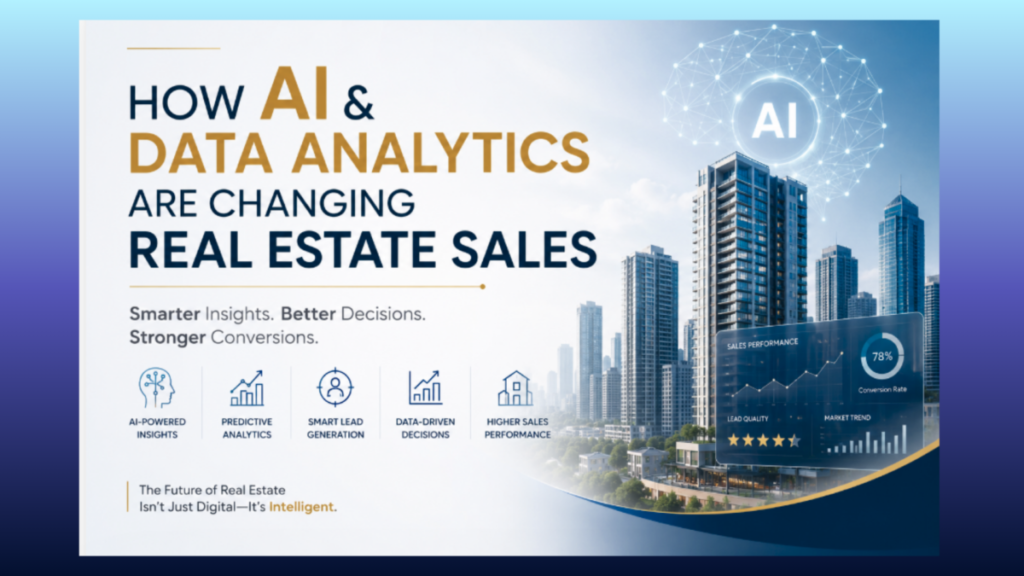
The real estate industry has traditionally been driven by relationships, market knowledge, and timing. While these fundamentals remain important, a new force is reshaping how properties are marketed, sold, and invested in: Artificial Intelligence (AI) and Data Analytics.
Today, successful real estate professionals are no longer relying solely on intuition. They are leveraging technology to understand buyer behavior, predict market trends, improve lead quality, and enhance customer experiences.
The future of real estate sales is becoming increasingly data-driven.
The Evolution of Real Estate Sales
A decade ago, property sales primarily depended on newspaper advertisements, referrals, and physical site visits. Today, buyers begin their property journey online, generating valuable data at every touchpoint.
Every search, click, inquiry, and interaction provides insights into customer preferences.
This is where AI and data analytics are creating a competitive advantage.
1. Smarter Lead Generation and Qualification
One of the biggest challenges in real estate sales is identifying serious buyers.
AI-powered CRM systems can analyze:
- Customer behavior
- Website activity
- Search patterns
- Engagement levels
- Property preferences
As a result, sales teams can prioritize high-intent prospects and focus their efforts where conversion potential is highest.
Instead of chasing hundreds of leads, agents can engage with the right prospects at the right time.
2. Predictive Analytics is Improving Investment Decisions
Modern investors want data-backed decisions.
Using predictive analytics, developers and investors can evaluate:
- Future growth corridors
- Infrastructure impact
- Demand projections
- Pricing trends
- Population movement patterns
This allows stakeholders to identify emerging opportunities before they become mainstream.
In many cases, data analytics is helping investors spot future hotspots years before significant appreciation occurs.
3. Personalized Customer Experiences
Today’s homebuyers expect personalization.
AI tools can recommend properties based on:
- Budget
- Location preferences
- Family requirements
- Lifestyle choices
- Search history
This creates a more relevant and efficient buying experience while increasing customer satisfaction.
The result is faster decision-making and improved conversion rates.
4. Enhanced Marketing Performance
Real estate marketing is becoming increasingly intelligent.
AI can now optimize:
- Digital advertising campaigns
- Audience targeting
- Content recommendations
- Lead nurturing sequences
- Customer engagement strategies
Rather than guessing which campaign will perform best, marketers can make decisions based on real-time performance data.
This leads to higher ROI and more efficient marketing spend.
5. Virtual Property Experiences
Technology is redefining property presentations.
AI-powered tools now support:
- Virtual property tours
- Interactive floor plans
- 3D visualizations
- Personalized property recommendations
These innovations allow buyers to explore projects remotely, reducing decision timelines and expanding market reach.
The Human Element Still Matters
Despite rapid technological advancements, real estate remains a people-centric industry.
AI can provide insights.
Data can improve decision-making.
Technology can increase efficiency.
However, trust, relationship-building, negotiation skills, and local market expertise continue to play a crucial role in successful transactions.
The most successful professionals will not be those who replace people with technology.
They will be those who combine human expertise with intelligent tools.
Final Thoughts
AI and Data Analytics are no longer future trends—they are becoming essential components of modern real estate sales.
Organizations that embrace data-driven strategies are likely to gain advantages in lead generation, customer engagement, operational efficiency, and investment decision-making.
As the industry continues to evolve, one thing is becoming increasingly clear:
The future of real estate belongs to professionals who can transform data into actionable insights and technology into meaningful customer experiences.
What role do you think AI will play in the future of real estate sales?