
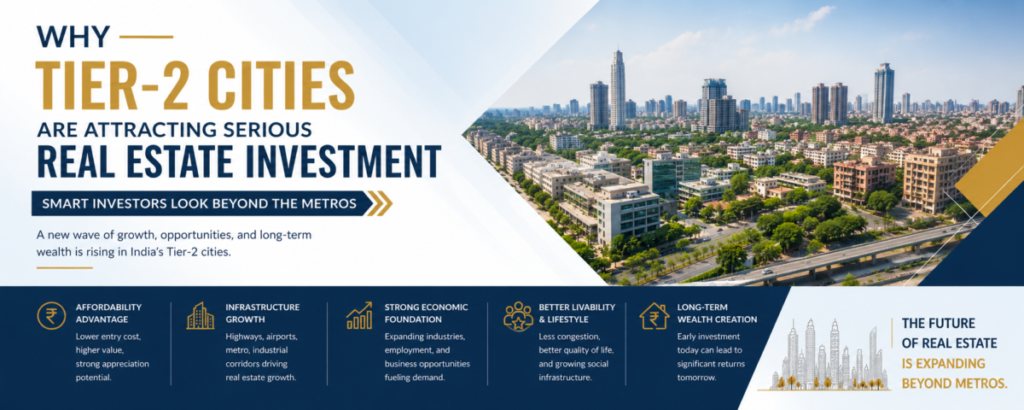
For decades, real estate investment in India was largely concentrated in major metropolitan cities. Mumbai, Delhi, Bengaluru, Hyderabad, and Pune dominated investor attention due to their employment opportunities, infrastructure, and economic activity.
However, a significant shift is underway.
Today, some of the most informed investors are looking beyond traditional metro markets and turning their attention toward Tier-2 cities such as Indore, Jaipur, Lucknow, Coimbatore, Surat, Chandigarh, and Bhubaneswar.
The question is simple:
Why are investors increasingly choosing Tier-2 cities over established metropolitan markets?
The answer lies in a combination of affordability, infrastructure development, changing lifestyle preferences, and long-term growth potential.
The Rising Importance of Tier-2 Cities
India’s urban growth story is evolving. While metro cities continue to attract businesses and talent, Tier-2 cities are rapidly developing into economic and residential hubs.
Improved road networks, airports, industrial corridors, IT parks, educational institutions, and healthcare infrastructure have significantly enhanced the attractiveness of these cities.
As a result, they are no longer viewed as secondary markets.
They are emerging as primary investment destinations.
Affordability Creates Opportunity
One of the biggest advantages of Tier-2 cities is affordability.
In many metropolitan areas, property prices have reached levels that limit future appreciation potential.
In contrast, Tier-2 cities still offer:
- Competitive property prices
- Lower entry barriers
- Better value per square foot
- Higher scope for future appreciation
Investors entering these markets today are often positioning themselves before prices reach their next growth cycle.
Infrastructure Is Driving Growth
Infrastructure remains one of the strongest indicators of future real estate appreciation.
Smart investors closely monitor:
- New highways and expressways
- Airport expansion projects
- Metro connectivity
- Industrial corridors
- Commercial developments
- Educational and healthcare infrastructure
When infrastructure improves, demand follows.
When demand follows, property values typically increase.
This pattern is visible across several successful real estate markets globally.
The Livability Advantage
A major trend shaping real estate demand is the shift from employment-driven decisions to lifestyle-driven decisions.
Today’s homebuyers increasingly prioritize:
- Quality of life
- Lower traffic congestion
- Better air quality
- Community living
- Open spaces
- Work-life balance
Tier-2 cities often provide these benefits while maintaining strong economic growth.
This creates sustained demand from both end-users and investors.
Why Indore Is a Strong Example
Indore represents the transformation taking place across India’s emerging cities.
The city has consistently attracted attention due to:
- Strong infrastructure development
- Expanding commercial activity
- Growing industrial investment
- Excellent connectivity
- High livability rankings
Growth corridors such as AB Road, Super Corridor, and emerging residential and commercial hubs continue to generate investor interest.
For long-term investors, such developments indicate strong potential for appreciation and demand growth.
The Shift from Speculation to Strategic Investing
Modern investors are becoming more analytical.
Rather than chasing short-term gains, they are focusing on:
- Infrastructure-led growth
- Demand fundamentals
- Population expansion
- Economic activity
- Livability factors
This strategic approach naturally favors Tier-2 cities where future growth potential remains significant.
What Investors Should Consider
Before investing in any Tier-2 market, evaluate:
✓ Infrastructure pipeline
✓ Employment generation
✓ Connectivity improvements
✓ Commercial activity
✓ Future development plans
✓ Demand trends
Successful real estate investing is rarely about timing the market perfectly.
It is about identifying growth before it becomes obvious.
Final Thoughts
The future of Indian real estate may not be defined solely by metropolitan cities.
Increasingly, it will be shaped by emerging urban centers that combine affordability, infrastructure, livability, and economic growth.
Tier-2 cities are no longer alternative investment destinations.
They are becoming some of the most compelling opportunities for long-term wealth creation.
The investors who recognize this shift early may be the ones best positioned to benefit from the next phase of India’s real estate growth story.